Paulo Brighenti
A união das coisas desiguais
É com a obra de Paulo Brighenti (Lisboa, 1968) que retomamos o ciclo de exposições Reset 23/26, com curadoria da Artadentro e realizado em colaboração com o Museu Municipal de Faro.
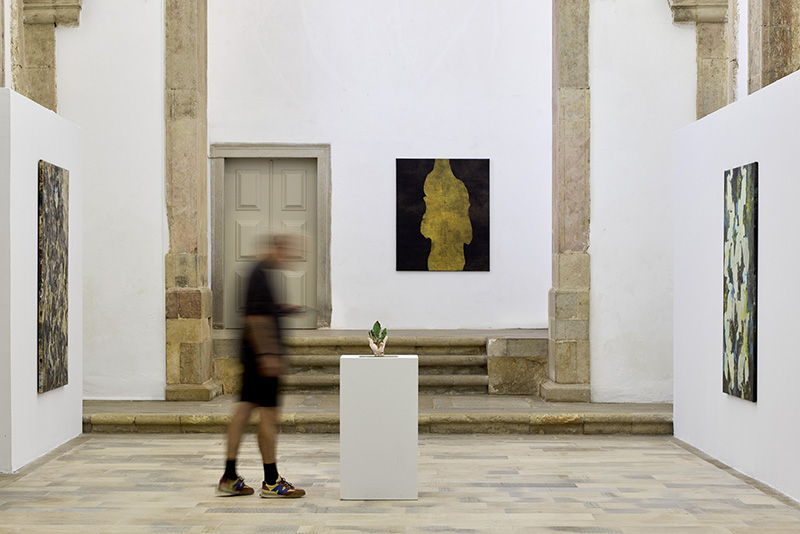
A exposição “A união das coisas desiguais”, de Paulo Brighenti, reúne um conjunto de pinturas e esculturas que se afirmam como lugares de espiritualidade e homenagem, a pessoas, momentos e memórias, pessoais, coletivas e históricas.
Na sua prática, Brighenti repensa os limites da pintura, expandindo-a ao desenho, à escultura e ao vídeo, num exercício contínuo de questionamento das tradições pictóricas e da sua relevância contemporânea. Os temas do efémero, da ruína, da memória e dos ciclos naturais surgem entrelaçados com forças invisíveis, orgânicas ou espirituais, que habitam e moldam o mundo.
O artista fez a sua formação no Ar.Co em Lisboa e expõe regularmente desde 1995 em Portugal e no estrangeiro. A sua obra integra as mais importantes colecções de arte contemporânea nacionais e, também, várias colecções internacionais de relevo.
Artadentro
2025
www.artadentro.com/paulo_brighenti.htm
O coração pode abraçar
O místico renano Eckhart usava o verbo florir para qualificar um dos modos de manifestação de Deus no homem. O teólogo alemão — viveu na transição do século XII para o XIII —, num dos seus sermões, o segundo, afirma: no intelecto “Deus verdece e flori sempre, em toda a felicidade e em toda a glória que é ele próprio”, enquanto, na vontade, “Deus, sem descanso, ‘arde’ e ‘queima’ com toda a sua doçura e com todas as suas delícias”.
A dimensão cósmica do pensamento de Eckhart é aqui sublinhada pela ligação aos elementos naturais: o fogo, a terra, a água e o ar. Esse verdecer divino pode ser também associado à “viriditas” ou “verdor”, palavra que, em contexto teológico, serve alegoricamente para indicar vitalidade, fertilidade, fecundidade e exuberância, entre outros significados.
A monja medieval undecentista Hildegarda de Bingen, também conhecida como Sibila do Reno, interpretava esta substância ou “suco”, presente em plantas e seres humanos, como um novo humor, essa força vital que contrapunha à aridez, essa vingança divina.
A viriditas é assim a seiva do universo: força divina que germina na natureza, cura corpos, fecunda almas e convoca à reverência cósmica. Como escreveu Hildegarda: “Tu incandesces como a aurora e ardes como a chama do sol”. O seu legado místico é um apelo a cultivar o “verdor” dentro e ao redor de nós – antídoto para a aridez do mundo actual.
O trabalho de Paulo Brighenti é profundamente espiritual. O facto de ter o seu ateliê, em Maceira, Torres Vedras, próximo de vinhas, moinhos, cercais, matagais, serras e florestas, fazem com que o artista esteja próximo da natureza — ao longe vê-se o mar. Essa ligação a este ecossistema faz com que alguns elementos surjam na sua obra, como búzios, plantas, flores, pássaros, troncos e árvores. A morte, contraponto da viriditas, atravessa igualmente a produção do autor: são os casos das caveiras ou das mãos decepadas.
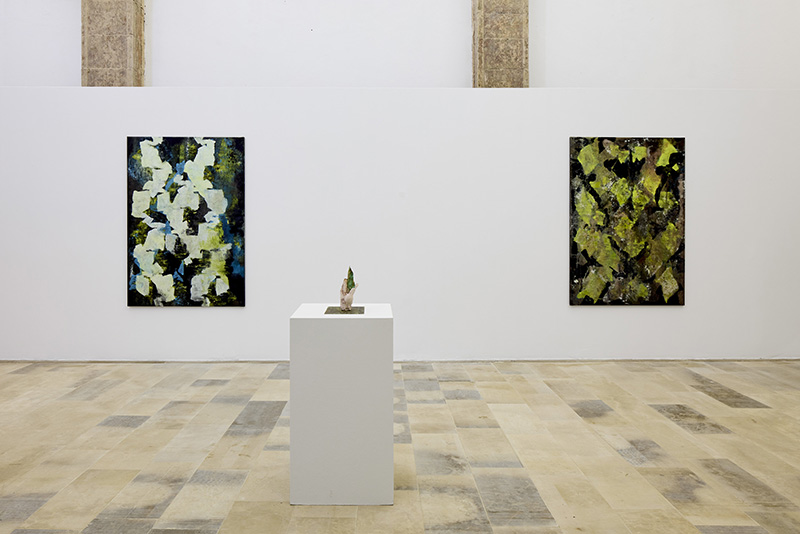
Na exposição “A união das coisas desiguais”, de Paulo Brighenti, vemos mãos com dedos amputados – algumas pessoas do Paleolítico Superior cortavam estes órgãos no âmbito de sacrifícios. Nos nossos dias, esta prática resulta muitas vezes da extrema tristeza pela perda de um ente querido; ou ainda de formas de punição ou tortura.
Das mãos florescem plantas em cobre: a viriditas que irrompe de um corpo inerte, trazendo, dessa forma, uma pulsão de vida a estas figuras lesionadas – as peças assemelham-se mesmo a esculturas mortuárias.
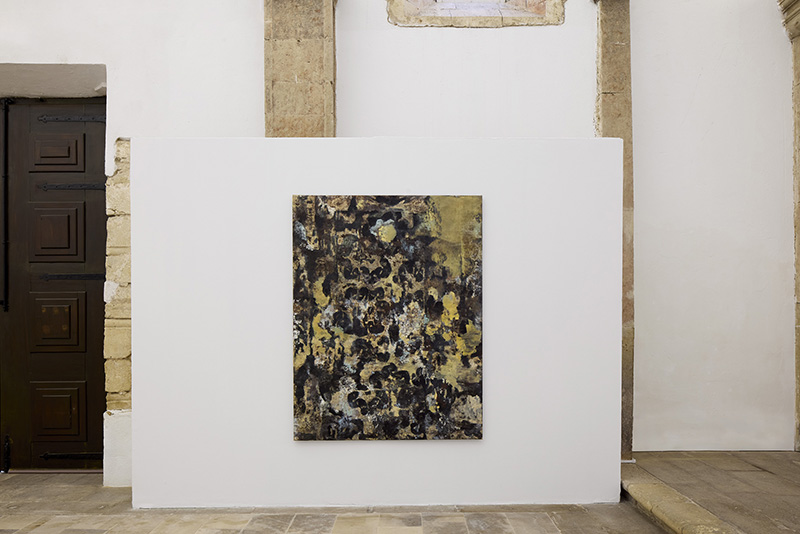
As mãos estão em diálogo com várias pinturas da série “Tapetes de oração”, nas quais formas abstractas – com excepção de um caso, onde surge uma figura feminina –, criam as condições para reflectirmos acerca do desapego, outro conceito fundamental em Eckhart, que o descreve como o “domínio de si na liberdade das coisas”.
Há uma linhagem de mulheres que percorrem a obra de Brighenti. Sara e as filhas. Esse mistério sem solução: a fecundidade criativa ou a neblina matinal. A natureza corre na seiva, no sangue, nos veios de quartzo. Mineral, vegetal, animal. As galinhas dão ovos diariamente.
A frase do compositor Robert Schumann para definir a missão do artista como o “projetar a luz nas profundezas do corpo humano”, citada por Kandinsky em “Do Espiritual na Arte” (1911), expressa o propósito transcendental da arte.
Comunicar o inefável, o indivisível, o indizível, corresponde a uma necessidade interior. Kandinsky defendia que a arte só é relevante quando nasce dessa urgência íntima —, caso contrário, é mero artifício. A obra verdadeira é assim um “organismo vivo”, gerado no silêncio da alma do artista, e o seu propósito é “tocar o invisível que habita todo ser humano”.
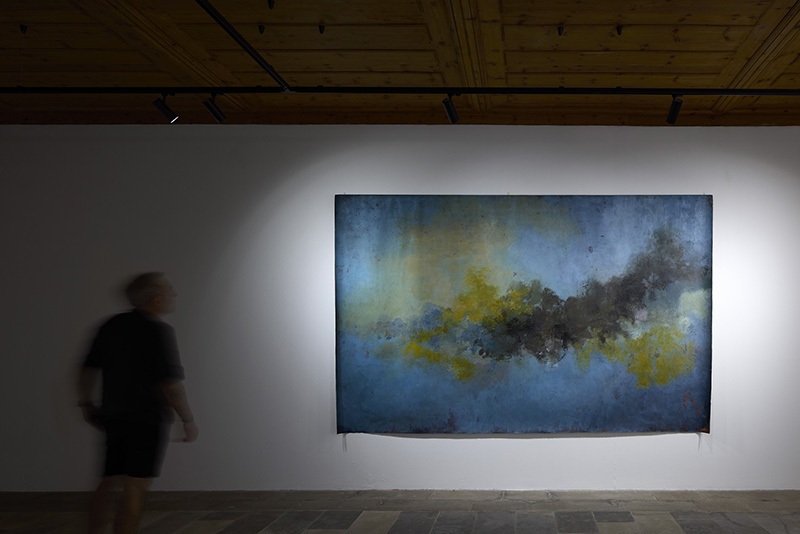
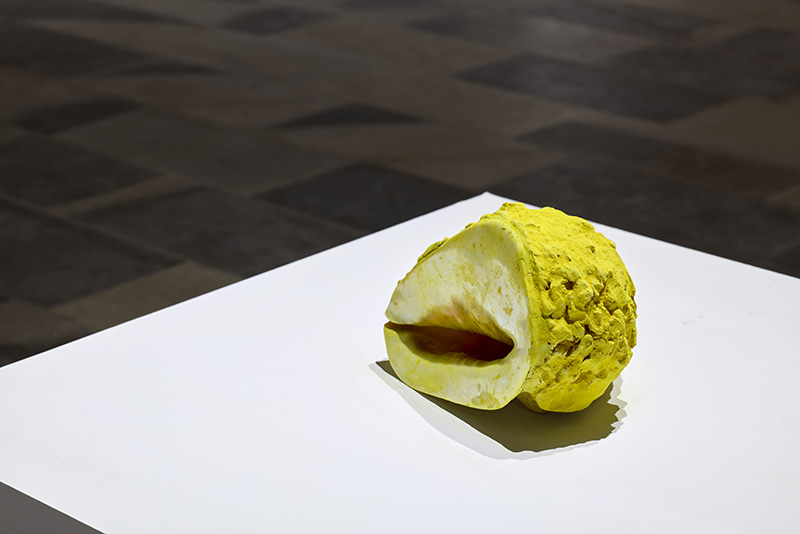
Uma outra pintura, intitulada “Sopro #4”, revela-nos a nuvem do não-saber: “Aquele que a mente não pode compreender, o coração pode abraçar.” Escutemos então, “com todos os sentidos em silêncio”, os sons que chegam do búzio coberto de pigmentos amarelos. É a nossa voz que ouvimos. Essa gramática que Brighenti traduziu em arte: uma corrente de ar que anuncia o milagre.
Óscar Faria
The Heart Can Embrace
The Rhineland mystic Eckhart used the verb to blossom to describe one of the ways God manifests in man. The German theologian — who lived during the transition from the 12th to the 13th century — in one of his sermons, the second, states: in the intellect, “God greens and always blossoms, in all the happiness and all the glory that He Himself is,” while in the will, “God, without rest, ‘burns’ and ‘blazes’ with all His sweetness and all His delights.”
The cosmic dimension of Eckhart’s thought is highlighted here through his connection to the natural elements: fire, earth, water, and air. This divine greening can also be associated with viriditas or “greenness,” a word that, in theological contexts, is used allegorically to indicate vitality, fertility, fecundity, and exuberance, among other meanings.
The 11th-century medieval nun Hildegard of Bingen, also known as the Sibyl of the Rhine, interpreted this substance or “sap”, present in both plants and human beings, as a new humor — a vital force opposed to aridity, a divine vengeance.
Viriditas is thus the sap of the universe: a divine force that germinates in nature, heals bodies, fertilizes souls, and calls forth cosmic reverence. As Hildegard wrote: “You blaze like the dawn and burn like the flame of the sun.” Her mystical legacy is a call to cultivate “greenness” within and around us – an antidote to the aridity of the modern world.
The work of Paulo Brighenti is deeply spiritual. The fact that his studio, in Maceira, Torres Vedras, is close to vineyards, windmills, enclosures, thickets, mountains, and forests means the artist is in close connection with nature — in the distance, the sea can be seen. This link to the ecosystem allows certain elements to appear in his work, such as shells, plants, flowers, birds, trunks, and trees. Death, the counterpoint to viriditas, also traverses the artist’s production: as seen in skulls or severed hands.
In the exhibition “The Union of Unequal Things” by Paulo Brighenti, we see hands with amputated fingers – some people from the Upper Paleolithic period used to cut these limbs as part of sacrificial rituals. Today, such practices often stem from deep grief over the loss of a loved one, or from acts of punishment or torture.
From the hands sprout copper plants: the viriditas erupting from an inert body, thus bringing a life impulse to these injured figures – the pieces resemble funerary sculptures.
The hands are in dialogue with several paintings from the series “Prayer Rugs”, in which abstract forms – with the exception of one case, where a female figure appears – create the conditions for us to reflect on detachment, another key concept in Eckhart, which he describes as “self-mastery in the freedom from things.”
There is a lineage of women that runs through Brighenti’s work. Sara and the daughters. That mystery with no solution: creative fecundity or morning mist. Nature flows in the sap, in the blood, in the quartz veins. Mineral, vegetal, animal. The hens lay eggs daily.
The phrase by composer Robert Schumann defining the artist’s mission as “to project light into the depths of the human body”, quoted by Kandinsky in Concerning the Spiritual in Art (1911), expresses the transcendental purpose of art.
To communicate the ineffable, the indivisible, the unspeakable, corresponds to an inner need. Kandinsky believed that art is only relevant when born of this intimate urgency — otherwise, it is mere artifice. The true artwork is thus a “living organism,” generated in the silence of the artist’s soul, and its purpose is “to touch the invisible that dwells in every human being.”
Another painting, entitled “Breath #4”, reveals to us the cloud of unknowing: “That which the mind cannot comprehend, the heart can embrace.” Let us then listen, “with all the senses in silence,” to the sounds coming from the shell covered in yellow pigments. It is our own voice we hear. This grammar that Brighenti has translated into art: a current of air announcing the miracle.
Óscar Faria


